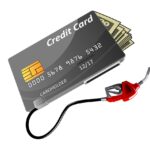
Fuel costs are rising, and you need to find a way to prevent the sharp increase from eating into your profits. As a trucking company owner, you could choose a business credit card or a fuel card/fleet card.
Knowing how each works helps guide your final choice. A credit card gives you a line of credit that you borrow against by making credit card purchases. Use your credit card at the pump, and the amount is deducted from your credit line.
The money you’ve charged is paid off through monthly installments or by paying the full balance by the due date. Since it’s revolving credit, you must pay interest on any remaining balance that isn’t paid off by the monthly closing date. Paying on time helps your credit score, while late payments can hurt it. Having too many credit cards can also negatively impact your score.
Fuel cards are often cash-secured, meaning you add cash to the card as needed. It works more like a debit card. Add money to that card and use it to purchase fuel. The purchase is deducted from the cash you’ve added to the card.
Those are the basics, but the right card for your needs depends on several other factors. Our guide helps you understand the advantages and disadvantages of each.
Consider Your Expenses and Business Model
Before deciding whether a business credit card or a fuel card is best, you need to consider how you operate your trucking company. How quickly are you paid? Is your current system working for you?
If you’re an independent owner-driver, you might handle all the paperwork yourself. That makes it hard to both run loads and keep up with office work. You have to hire a dedicated office worker, which means paying another salary and benefits.
A larger trucking company has over a dozen trucks in its fleet. Every driver needs a card for on-the-road use, but you need a way to set limits to prevent drivers from spending money on unauthorized items.
How you run your business, the size of your business, and your per-mile rate charged to brokers and shippers are all important factors.
Advantages and Disadvantages of Business Credit Cards
1. Use Them Anywhere
Business credit cards are definitely useful because you can use them anywhere that accepts that type of payment card, including most stores, restaurants, mechanics, and online payment systems.
If you’re on the road and face a brake issue, you can’t drive back to the truck garage with bad brakes. Plus, you might not have enough cash for the emergency repair. That’s when a business credit card comes in handy.
Charge for the emergency repair and pay for it over time. You might be able to pay as soon as your client pays, but you might need to make minimum payments until your cash reserve strengthens.
2. High Interest Rates and Misleading Offers
Credit cards usually have high non-promotional interest rates. This means the amount you “borrow” can become costly. The average APR on a business credit card was just over 21% in March 2026.
You might see an offer with a 0% APR and a free balance transfer, but it’s a limited-time deal, and if you haven’t paid back a balance transfer during that period, interest is retroactive from the time you received the card. Carefully read the fine print before deciding a promotional interest rate is as good as you think it is.
3. Impacts Your Credit Score
Credit cards hurt or help your credit history. The first point of impact is when the bank pulls your credit report to see if you qualify. That will slightly lower your score.
When used responsibly, they help prove that you pay your accounts on time and manage your charges. If you miss payments or charge more than you can pay back, you drop your credit score, making it hard to qualify for truck leases and business loans. Having too many credit cards or carrying balances exceeding 30% also harms your score.
4. Hard to Restrict How the Card Is Used
Some credit cards let you toggle access via the app or website. This helps prevent unauthorized use. While you can’t restrict how the card is used, you can set alerts to notify you when and where it’s used.
Advantages and Disadvantages of Fuel Cards
5. Self-Funded
Fuel cards require you to add funds. If you don’t top up your card or work with a freight factoring company to get paid to your fuel card, you could end up trying to purchase fuel and having the purchase denied.
6. Track Fuel Taxes and Line Items
Fuel cards make it easier to show what purchases were made (food, fuel, or both), the type of fuel purchased, and the fuel taxes paid.
7. Network Discounts
With a fuel card, you get a discounted price on gas or diesel. These wholesale prices help you save a lot of money on each fill-up. You may need to stick to specific chains, however, so see if it’s a universal card or a branded card for just one truck stop chain.
A Saint John Capital Fuel Card is good at over 35,000 repair facilities and 1,500 truck stops.
A Comparison at a Glance
| Fuel Card/Fleet Card | Business Credit Card | |
| Main Benefit | Cents off per gallon | Cash back or points |
| Card Controls | Fuel only setting | Post-purchase text alerts, card on/off |
| Funding | Self-funded or payments through freight factoring | Line of credit |
| Hidden Fees | Monthly or per transaction | APR and possible annual fee |
| Tracking | Driver ID, IFTA, Purchase type | Merchant category |
Saint John Capital Keeps Trucks Rolling
Consider some of your company’s biggest struggles. Your clients want NET 60 terms, so you send out an invoice for a job you completed on the 1st. You won’t see payment for almost two months. During those two months, you have all these expenses. These are national averages and may be substantially higher in some regions.
- Fuel – $3.99 (Gas) or $5.40 (Diesel) per gallon
- Insurance – $746 (specialty) or $954 (transport) per month
- Leased office space – $37 per square foot
- Used semi-truck – $1,200 per month
This doesn’t account for other expenses like the annual UCR fee, federal excise tax, state registrations, truck maintenance and repairs, wages, and benefits. They’ll increase your monthly costs.
When your truck travels 100,000 miles in one year, you use a lot of fuel. The average fuel economy for a semi-truck is around 7 mpg. That breaks down to:
- About 14,286 gallons of fuel were used for those trips
- Fuel costs of around $57,000 (gas) and $77,144 (diesel)
Consider the savings:
- Credit Card – 2% cash back on every gallon you purchase, which is $1,542.90 back with diesel or $1,140 with gas.
- Fuel Card – Suppose you get a 30-cent discount on every gallon you purchase at a participating retailer. Enjoy savings of around $4,285.
You save far more with a fuel card, plus you gain additional benefits like same-day payments, no impact on your credit score, and easier bookkeeping and office management because Saint John Capital’s intuitive software integrates with TMS.
With Saint John Capital’s gas card, get payments straight to the card. Do the work, send us your payment request, get paid, and have money for gas or diesel the same day you complete the delivery. Even better, take on more work and use unlimited credit checks to investigate a broker or shipper before you agree to work for them.
Saint John Capital makes it easy to get a free rate quote. See how little it costs to get paid the same day. Even better, there are no hidden fees, and we offer a 60-day trial so you can see whether our freight factoring arrangements and fuel discounts are right for you.